By Score Smart · 2026-09-11
If you are applying for Australian permanent residency through a skilled migration visa, you have almost certainly heard someone say "you need 7 each." It sounds simple enough — until you realise PTE Academic does not use band scores the way IELTS does, and a 7 in IELTS is not the same number in PTE.
This guide explains exactly what "7 each" means when translated into PTE Academic scores, how many PR points each English level is worth, and what score you realistically need to target based on your visa pathway. No vague advice — just the numbers, the official source, and a clear action plan.
What Does "PTE 7 Each Score" Actually Mean?
When people say "7 each in PTE," they are referring to the IELTS Band 7 equivalent. PTE Academic does not use a 0–9 band scale — it scores each skill on a scale of 10–90. So "PTE 7 each" translates to a specific set of PTE scores across Speaking, Writing, Reading, and Listening.
The Australian Department of Home Affairs recognises three English proficiency levels for points-based skilled migration visas:
| English Level | IELTS Equivalent | PTE Score Required (Each Skill) | PR Points Awarded |
|---|---|---|---|
| Competent English | 6 each | 50 each | 0 points |
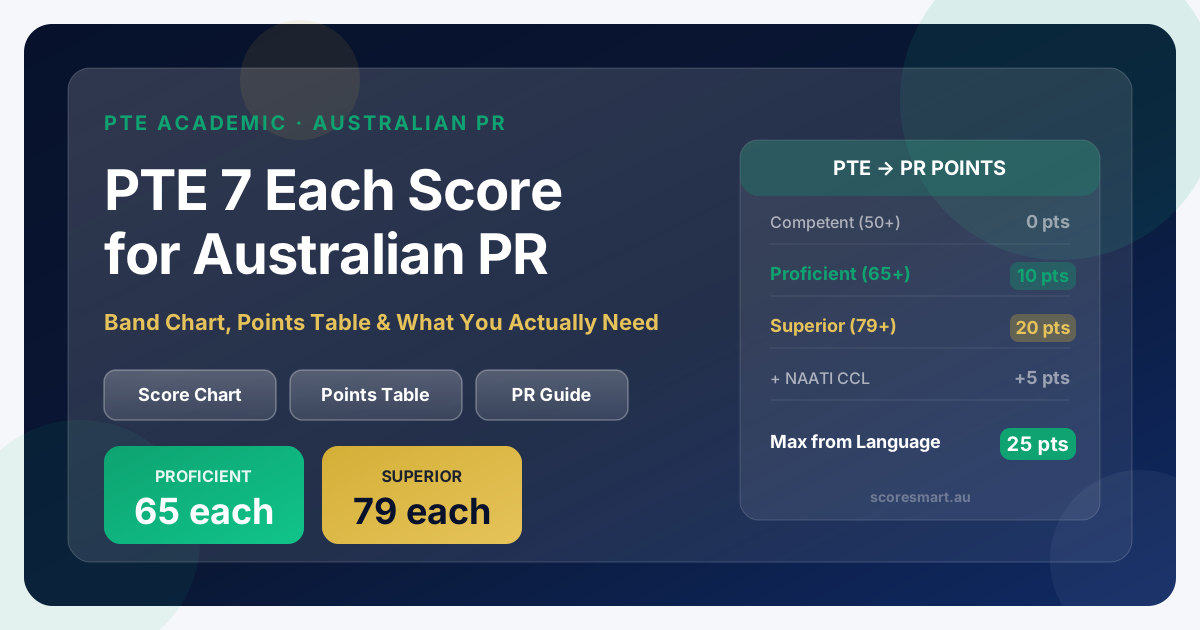
| Proficient English | 7 each | 65 each | 10 points |
| Superior English | 8 each | 79 each | 20 points |
So when someone says "PTE 7 band score" or "7 each in PTE," they mean a minimum of 65 in every skill — Speaking 65, Writing 65, Reading 65, and Listening 65. This qualifies as Proficient English and earns you 10 PR points. If you are preparing in a specific city, our PTE classes in Melbourne, Sydney, and Brisbane are designed to help students hit exactly this target.
PTE Score Chart — Full Band-to-Points Breakdown
Here is the complete PTE score chart showing how each English level maps to IELTS bands and the points you receive under the Skilled Migration points test:
| PTE Score (Each Skill) | IELTS Band Equivalent | English Level | Points for PR | Typical Use Case |
|---|---|---|---|---|
| 30–35 | 4.5 | Functional | 0 | Some partner visas, basic requirement |
| 36–49 | 5–5.5 | Vocational | 0 | Some employer-sponsored visas |
| 50–64 | 6 each | Competent | 0 | Minimum threshold for most skilled visas |
| 65–78 | 7 each | Proficient | 10 | Most common PR target for skilled migrants |
| 79–90 | 8 each | Superior | 20 | Maximum English points — competitive advantage |
Important: You must meet the minimum in every skill. Scoring 79 in Speaking but 64 in Writing still counts as Competent, not Proficient. There is no averaging — each module must independently hit the threshold. Not sure where you stand? Read our guide on how much PTE score is required for Australia PR, visa, and university.
PTE Points for PR — How English Scores Fit the Points Test
The points test for visa subclasses 189, 190, and 491 awards up to 20 points for English proficiency. Here is how English stacks up against other points categories:
| Points Category | Maximum Points |
|---|---|
| Age (25–32) | 30 |
| English Proficiency | 20 |
| Overseas Work Experience (8+ years) | 15 |
| Australian Work Experience (8+ years) | 20 |
| Education (PhD) | 20 |
| NAATI CCL (Community Language) | 5 |
| Partner Skills | 10 |
| State Nomination (190) | 5 |
English is one of the fastest categories to improve. Moving from Competent (0 points) to Proficient (10 points) or Superior (20 points) can happen in 4–8 weeks with focused preparation — far quicker than gaining additional work experience or completing further study.
This is exactly why most migration agents advise their clients to maximise their English score first. It is the lowest-hanging fruit in the points test. Want to understand the difference between the two main English tests? Check our detailed PTE vs IELTS comparison.
PTE 6 Band Score — Is Competent English Enough?
A PTE 6 band score means scoring 50+ in each skill. This qualifies as Competent English, which is the minimum requirement for most skilled visas — but it awards zero additional points.
If your total points already comfortably exceed the invitation threshold for your occupation (typically 65–85 points depending on the subclass and occupation), Competent English may be sufficient. But for competitive occupations where invitation rounds regularly clear at 80+ points, you will almost certainly need Proficient (65 each) or Superior (79 each) to receive an invitation.
We covered competent English requirements in detail in our Competent English in PTE (2026 guide).
Bottom line: Competent English gets you through the door. Proficient or Superior English gets you the invitation.
PTE 8 Each Score — Unlocking 20 Points With Superior English
A PTE 8 each score means hitting 79 or above in every skill. At Score Smart, this is the target we set for students who want maximum PR points. The official thresholds from Pearson are:
| Skill | Superior English Minimum |
|---|---|
| Speaking | 79 |
| Writing | 79 |
| Reading | 79 |
| Listening | 79 |
Some students aim even higher. Our target outcomes at Score Smart are Speaking 88, Writing 85, Reading 70, Listening 69 — because the integrated scoring in PTE means boosting your strongest skills can pull up weaker communicative scores. But for the PR points test, 79 each is the number. Our guide to scoring 8 each in PTE within one month breaks down the exact strategy.
Proficient English PTE Score — The Sweet Spot for Most Applicants
For most skilled migration applicants, the proficient English PTE score of 65 each is the practical target. Here is why:
- It awards 10 points — often enough to push your total over the invitation threshold
- It is achievable within 4–6 weeks of focused preparation for most intermediate-level speakers
- The jump from 50 (Competent) to 65 (Proficient) is smaller than the jump from 65 to 79 (Superior)
- If you also pass NAATI CCL, you pick up another 5 points on top — giving you 15 total from language alone
That said, if your occupation is highly competitive (Accounting, IT, Engineering), the extra 10 points from Superior English (79 each) can make the difference between waiting months for an invitation and getting one in the next round. Students across Perth, Adelaide, and Canberra often target Superior because state nomination thresholds in these regions favour higher English scores.
Which Score Should You Target? A Practical Decision Framework
Stop guessing and use this framework:
- Calculate your current points total without English (age + experience + education + other factors)
- Check the latest invitation round for your occupation on the SkillSelect results page
- Work backwards: If you need 10 more points → target Proficient (65 each). If you need 20 → target Superior (79 each)
- Add NAATI CCL if you speak Hindi, Punjabi, Nepali, or Urdu — that is an easy 5 extra points
How Long Does It Take to Reach Each Level?
| Current Level | Target | Typical Preparation Time |
|---|---|---|
| PTE 36–49 | Competent (50 each) | 3–4 weeks |
| PTE 50–59 | Proficient (65 each) | 4–6 weeks |
| PTE 60–72 | Superior (79 each) | 4–8 weeks |
| PTE 40–55 | Superior (79 each) | 8–12 weeks |
These timelines assume daily practice with AI-scored mock tests and structured coaching. Self-study without feedback typically takes 2–3 times longer because students repeat the same mistakes without realising it. Read our smarter PTE strategy for 2026 for a task-by-task breakdown.
Common Mistakes That Keep Students Stuck Below 65
After coaching 1,200+ students, these are the patterns we see most often:
- Ignoring Writing: Students spend 80% of their time on Speaking and neglect Summarise Written Text and Write Essay — the two tasks that also feed into Reading scores
- Practising without feedback: Repeating Read Aloud 50 times without knowing your pronunciation errors just reinforces bad habits
- Skipping mock tests: Full-length mock tests under timed conditions reveal stamina issues that sectional practice never exposes. Try a free PTE mock test to see where you stand
- Memorising templates blindly: Templates work, but only when you understand why each phrase scores well — otherwise you sound robotic and lose fluency marks
- Not understanding integrated scoring: PTE's cross-skill scoring means a weak Speaking performance can drag down your Listening score. Our PTE Listening improvement guide explains how this works
Start With a Free Diagnostic
If you are not sure where you stand, book a free trial at Score Smart. You will get a diagnostic mock test, a personalised score analysis, and a clear roadmap showing exactly how many weeks you need to hit your target — whether that is Proficient (65 each) or Superior (79 each).
We offer PTE online classes with AI-scored practice, weekly mock tests, and one-on-one feedback from trainers who have personally scored 79+ in PTE. If you also need the extra 5 PR points, our NAATI CCL coaching covers Hindi, Punjabi, Nepali, and Urdu.
Check out our PTE prediction files for the latest high-frequency questions, or browse our free PTE resources to start practising today.
Your PR journey does not need to be complicated. Know your numbers, pick the right target, and prepare with a plan — not hope.