With your PTE Academic exam coming up in October 2026, the right practice material can make the difference between falling just short and clearing your target score. Prediction files give you that edge — a curated set of high-frequency questions drawn from what recent test takers have reported across exam centres in Australia and around the world.
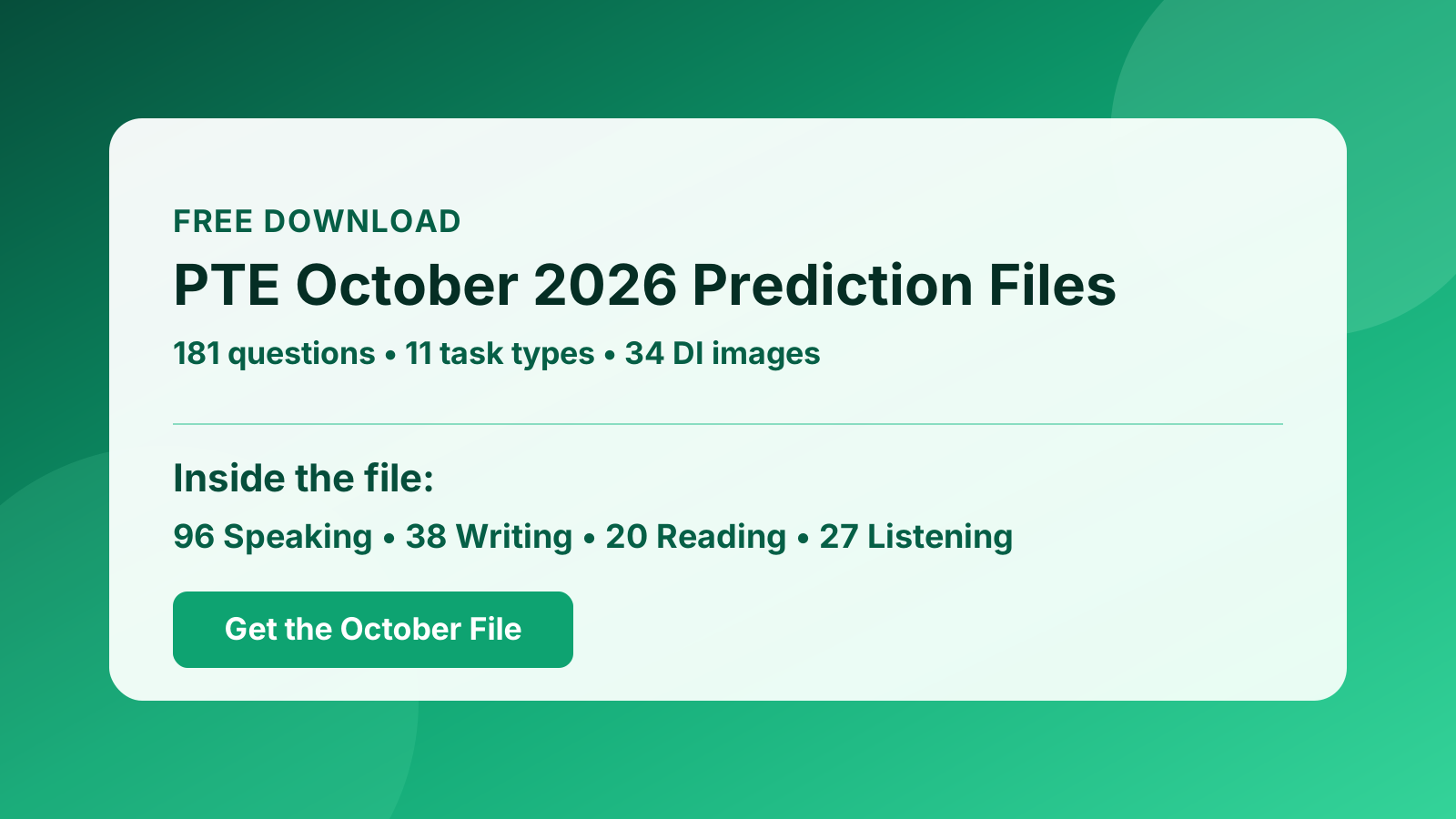
Our PTE October 2026 Prediction File packs 181 questions across 11 task types, plus 34 Describe Image visuals — making it one of the most comprehensive monthly files we have released. Whether you are chasing 65+ or targeting 79+ for PR points, this file covers the tasks that carry the most weight on your scorecard.
What's Included in the PTE October 2026 Prediction File?
The October file spans every scored task type in Speaking, Writing, Reading, and Listening. Access it on our PTE Prediction Files page, or combine it with Score Smart PTE coaching for trainer-led walkthroughs. For official exam information, see Pearson PTE Academic.
| Module | Task Types | Questions |
|---|---|---|
| Speaking | Read Aloud, Describe Image, Re-tell Lecture, Respond to a Situation, Summarize Group Discussion | 96 |
| Writing | Summarize Written Text, Write Essay | 38 |
| Reading | Fill in the Blanks (Dropdown), Fill in the Blanks (Drag & Drop) | 20 |
| Listening | Summarize Spoken Text, Write from Dictation | 27 |
| Total | 11 Task Types | 181 Questions |
Speaking Prediction Questions (96)
Speaking feeds into pronunciation, oral fluency, and content scores — and with 96 questions, this month's file gives you plenty of room to drill every task type until your delivery feels automatic.
Read Aloud — 26 Questions
Read Aloud is the opening salvo of your PTE exam and it sets the tone for everything that follows. October's file includes 26 passages spanning academic topics that keep reappearing — economics, biology, technology adoption, and historical events. Practise reading each passage twice: once slowly for accuracy, then at a natural conversational pace. Pay attention to stressed syllables and sentence-final intonation — these are the micro-signals the scoring algorithm uses to assess fluency.
Describe Image — 34 Questions
This is the largest single section in the October prediction file. The 34 images cover every visual format you might encounter on exam day:
- Bar Charts and Grouped Bar Charts
- Line Graphs (single and multi-line)
- Pie Charts
- Tables with comparative data
- Process Diagrams and Flowcharts
- Maps and Floor Plans
- Venn Diagrams
- Mixed-format infographics
Stick to a consistent template for each image type. Open with what the image shows, describe the key data points or trends, and close with a summary observation. Aim to finish within 35–38 seconds so you are not cut off at the 40-second mark.
Re-tell Lecture — 10 Questions
Re-tell Lecture tests your ability to listen to a short academic talk and reproduce the key ideas in your own words. The 10 lectures in October's file cover topics like environmental policy, technological innovation, education systems, and public health. While listening, jot down 3–4 keyword triggers on the erasable notepad — these anchor your retelling and keep you on track without memorising word-for-word.
Respond to a Situation — 11 Questions
This newer task evaluates how naturally you handle everyday academic and workplace scenarios. October's practice situations include contexts such as:
- Asking a professor for feedback on a draft submission
- Declining a colleague's invitation politely
- Reporting a maintenance issue in student housing
- Explaining a scheduling conflict to a team leader
- Offering to help a classmate who missed a session
- Negotiating a deadline extension with a supervisor
Focus on sounding natural and polite — the scoring system rewards appropriate register and clear communication over complex vocabulary.
Summarize Group Discussion — 15 Questions
Summarize Group Discussion requires you to listen to a panel of speakers debating a topic and then summarise the main arguments in a single spoken response. The 15 questions in October's file cover common discussion themes including workplace flexibility, digital education, healthcare funding, and urban development. Identify each speaker's core position before you start speaking — a structured summary scores significantly higher than a rambling recap.
Writing Prediction Questions (38)
Writing is often the module where targeted practice pays off fastest. With 38 questions this month, you have more than enough material to build confidence before your exam.
Summarize Written Text — 18 Questions
Each Summarize Written Text question gives you an academic passage and asks for a single sentence of 5–75 words that captures the main idea. The 18 passages in October's file cover topics like migration patterns, climate adaptation, digital literacy, economic inequality, and public policy. Use the 10-minute time limit wisely — most students who practise regularly can finish in 6–7 minutes once they develop a reliable sentence structure. Start with the subject, add the main action, and close with the key outcome or implication.
Write Essay — 20 Questions
October's essay prompts span the full range of opinion-based and discussion topics that PTE favours — technology versus privacy, government spending priorities, education access, immigration policy, and environmental responsibility. Write at least 8–10 of these under strict 20-minute timed conditions. Check your word count (aim for 200–280 words), grammar, and paragraph structure before moving on. A well-organised four-paragraph essay with clear connectors will outscore a longer but messy one every time.
Reading Prediction Questions (20)
Reading in PTE is about recognising vocabulary in context and making quick decisions under time pressure. The October file gives you 20 questions across the two fill-in-the-blanks task types.
Fill in the Blanks (Dropdown) — 6 Questions
Dropdown FIB questions present a passage with dropdown menus where you pick the correct word from a short list. They test collocations and contextual vocabulary — not just individual word meaning, but how words sit naturally together. Read the full sentence surrounding each blank before choosing. Context clues before and after the gap are your best guide.
Fill in the Blanks (Drag & Drop) — 14 Questions
Drag and Drop FIB gives you a word bank and asks you to place words into blanks within a passage. The 14 questions in October's file feature academic vocabulary that has been appearing consistently in recent test sessions. Pay close attention to parts of speech — if the blank sits between "the" and a noun, you need an adjective, not a verb. Eliminate impossible options first to narrow your choices quickly.
Listening Prediction Questions (27)
Listening contributes to your integrated Writing and Reading scores as well, making it one of the most valuable modules to practise thoroughly.
Summarize Spoken Text — 7 Questions
Each question plays a short lecture and asks you to write a 50–70 word summary within 10 minutes. October's file includes transcript references so you can verify your understanding after your first attempt. Topics range from urban planning and renewable energy to media studies and cross-cultural communication. Structure your response with a clear opening sentence, 2–3 supporting points, and a brief conclusion — this format consistently scores well.
Write from Dictation — 20 Questions
Write from Dictation is the single highest-scoring Listening task per item and it also feeds into your Writing score. You hear a sentence once and type it word-for-word. The 20 sentences in October's file reflect the length and complexity of what recent test takers have reported. Even one missing word costs marks on both your Listening and Writing scores, so practise typing immediately after hearing each sentence. Use headphones and a quiet room — accuracy depends on catching every word the first time.
October vs September — What Changed?
The October file is significantly larger than September's. Here's a side-by-side comparison:
| Metric | September 2026 | October 2026 |
|---|---|---|
| Total Questions | 87 | 181 |
| Task Types Covered | 10 | 11 |
| Describe Image Visuals | 9 | 34 |
| Write from Dictation | 7 | 20 |
| Write Essay | 10 | 20 |
| Read Aloud | 9 | 26 |
The biggest jump is in Describe Image (9 → 34) and Write from Dictation (7 → 20) — two of the highest-impact task types for your final score. If you used the September file, the October file builds on that foundation with fresh questions and broader coverage.
Why Practise with Prediction Files?
Students who use prediction files alongside structured preparation typically benefit because they:
- Concentrate revision on the most frequently reported question patterns
- Build familiarity with recurring exam topics and visual formats
- Reduce test-day anxiety by eliminating the surprise factor
- Save valuable preparation time during the final week
- Strengthen templates for Speaking and Writing responses
- Pinpoint weak areas before the real exam
Are PTE Prediction Files Accurate?
Prediction files are not official exam papers and should never be treated as leaked content.
They are compiled from high-frequency questions that recent test takers have reported across multiple exam sessions, then organised into structured practice sets. They help you revise commonly repeated question patterns and stay comfortable with the latest exam trends. The October file itself notes that these are high-frequency practice materials, not leaked or guaranteed exam content.
Always pair prediction file practice with a full PTE mock test and review official scoring guidance on Pearson PTE scoring. If you need an Australian visa, confirm your target score against Department of Home Affairs English requirements.
How to Use the October Prediction File
For the best results:
- Start with Speaking — complete all 96 questions across at least two sessions. Record yourself on Read Aloud and Describe Image, then listen back critically.
- Memorise one solid template each for Describe Image, Re-tell Lecture, and Summarize Group Discussion. Consistency beats creativity here.
- Practise every Summarize Written Text question within the 10-minute time limit. If you consistently finish under 7 minutes, your structure is working.
- Write at least 8 essays under strict 20-minute timed conditions. Focus on paragraph structure and connectors — not fancy vocabulary.
- Work through all 20 Reading FIB questions without interruptions to simulate real exam pacing.
- Practise Write from Dictation with headphones in a quiet space. Type each sentence immediately — do not pause to think mid-sentence.
- Revisit your weakest task types during the final 3–4 days before your exam.
Who Should Use These Prediction Files?
These prediction files are ideal for:
- Students sitting PTE in October or November 2026
- Candidates targeting 65+ overall for visa applications
- Students aiming for 79+ for Australian PR points
- First-time PTE test takers who want to know what to expect
- Repeat candidates looking to close a 5–10 point gap on their target score
Frequently Asked Questions
Are these official Pearson questions?
No. These are practice questions compiled from frequently reported exam content shared by recent test takers across Australia and globally.
How many questions are included?
The October 2026 prediction file contains 181 questions across 11 task types, plus 34 Describe Image visuals.
Which module has the most questions?
Speaking has the most with 96 questions, covering five task types: Read Aloud (26), Describe Image (34), Re-tell Lecture (10), Respond to a Situation (11), and Summarize Group Discussion (15).
Does the file include Write from Dictation?
Yes. October's file includes 20 Write from Dictation sentences — nearly triple what was in the September file. This is the highest-value Listening task in PTE scoring.
Is this file bigger than the September one?
Yes. October has 181 questions across 11 task types compared to September's 87 questions across 10 task types. The Describe Image section alone grew from 9 to 34 images.
Should I rely only on prediction files?
No. Prediction files work best alongside mock tests, vocabulary building, grammar practice, and structured coaching. They are a supplement — a focused revision tool for your final weeks, not a replacement for proper preparation.
Can these questions appear in my exam?
Some may appear in similar or identical forms, but no prediction file can guarantee the exact exam questions. Use them to build familiarity with question patterns, not to memorise answers.
Download the PTE October 2026 Prediction File
Get access to the October 2026 PTE Prediction File and practise the 181 most expected questions before your exam.
What's included:
- 96 Speaking Questions (RA, DI, RTL, RtaS, SGD)
- 38 Writing Questions (SWT, WE)
- 20 Reading Questions (FIB Dropdown, FIB Drag & Drop)
- 27 Listening Questions (SST, WFD)
- 181 Total High-Frequency Questions across 11 Task Types
Access the October 2026 prediction file →
Start practising today and give yourself the best shot at hitting your target PTE score. Want structured coaching with weekly mocks and trainer feedback? Book a free trial with Score Smart.