By Score Smart Team · 2026-07-27
Every week, we talk to students who feel stuck. They've studied, they've taken the test, and the score that comes back doesn't reflect the work they put in. It's frustrating — especially when a PR application, a visa, or a university offer is riding on hitting a specific number.
MD Shoabul Islam was in exactly that position. This is his story — and a look at exactly what we did to help him turn things around in under two weeks.
Where Shoabul started?
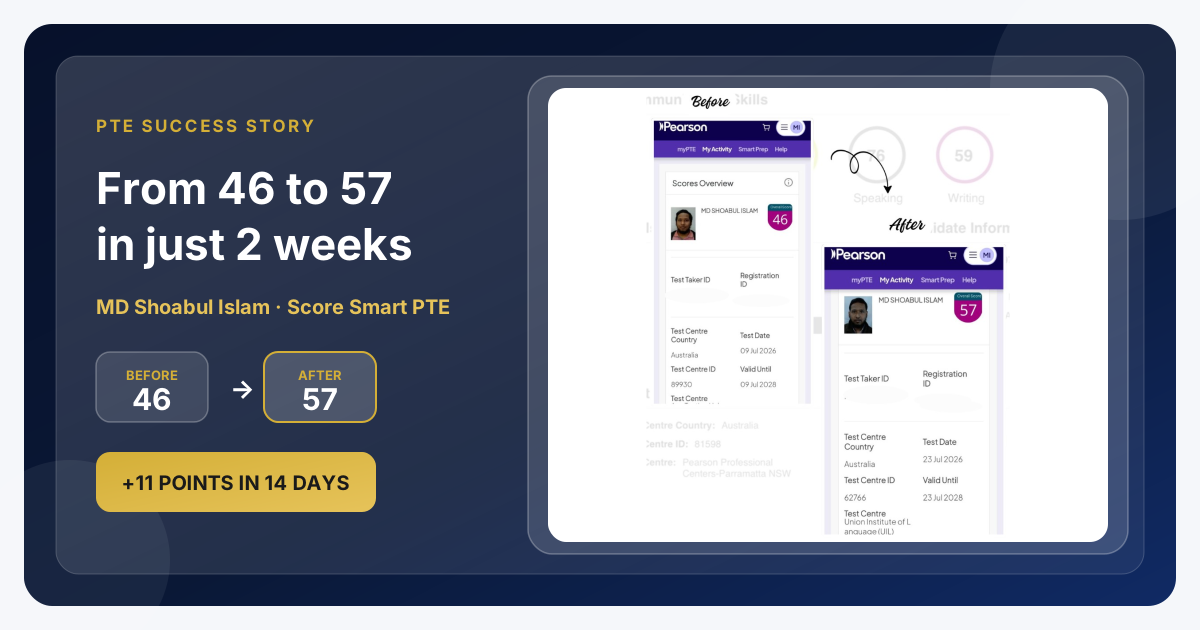
Shoabul sat his PTE Academic exam on 9 July 2026 at a Pearson Professional Centre in Australia. His overall score came back at 46 — below what he needed, and not reflective of how much groundwork he'd already put in.
If you've been in this spot, you know the feeling: you understand the exam format, you've done the practice tests, but somehow the number on the scorecard doesn't move the way it should. That's rarely a "study harder" problem. It's almost always a "study differently" problem — and that's where coaching makes the difference between another disappointing attempt and a genuine breakthrough.
The diagnosis: finding where the marks were actually being lost
Before we touched a single practice question with Shoabul, we started with something most self-study candidates skip entirely: a proper diagnostic breakdown of why the score was where it was.
PTE Academic doesn't just grade whether your answer is "good" — it scores very specific, mechanical things: response timing, pronunciation and fluency patterns, keyword density in written responses, structure in essays, and how well spoken answers map to the source content. A student can be a strong English speaker and still lose significant marks to habits they don't even know they have.
For Shoabul, that meant identifying:
Which item types were quietly costing him the most points
Timing issues that were cutting responses short or running him out of time
Pronunciation and fluency patterns the AI scoring engine was penalizing
Structural gaps in his Writing responses that were capping his score regardless of content quality
What our coaching actually looked like?
Once we knew where the gaps were, Shoabul went through a focused, two-week coaching sprint built around his specific weak points — not a generic revision course. That's the core of how ScoreSmart works, and it's what made the difference here.
1. Section-specific strategy, not generic tips: Instead of broad "how to improve your English" advice, Shoabul worked through targeted strategies for each section — Speaking, Writing, Reading, and Listening — built around how PTE actually scores each item type.
2. Real, exam-condition mock tests: Shoabul sat multiple full-length mock tests under timed, real exam conditions. This is one of the most underrated parts of PTE prep: knowing the content isn't the same as performing under the clock, and mock tests close that gap fast.
3. One-on-one tutor feedback: Rather than marking answers right or wrong, our tutors gave Shoabul specific, actionable feedback after every practice attempt — the kind of granular correction that's nearly impossible to get from self-study or generic YouTube prep.
4. Smart Prep tools for targeted practice: Shoabul used our Smart Prep question bank to drill specifically the item types that were weakest for him, rather than spreading his limited prep time evenly across everything.
5. A tight, focused timeline: No months-long course, no overwhelming syllabus. Just two weeks of high-intensity, targeted coaching aimed squarely at closing the specific gaps in his profile.
The result: 46 to 57 in two weeks
Shoabul returned to the test centre on 23 July 2026 — this time at Union Institute of Language (UIL) — and sat the exam again.
His overall score came back at 57. An 11-point jump, in under a fortnight, with no wasted study time on things that weren't moving the needle.
That's not a fluke, and it's not about "trying harder" the second time. It's what happens when coaching is built around a real diagnosis of where a student's marks are actually being lost.
Why students choose ScoreSmart?
Shoabul's result isn't an isolated case — it's what our coaching model is designed to produce. A few things set our approach apart:
Diagnostic-first coaching — we identify exactly where your score is being capped before building a study plan, instead of guessing
Experienced, named tutors across PTE, IELTS, NAATI CCL, and LanguageCert who specialise in exam-specific scoring mechanics, not just general English tuition
Smart Prep question bank with targeted practice by item type and weak area
Full-length mock tests under real exam timing and conditions
Flexible, intensive coaching timelines for students working against a deadline — whether that's two weeks or two months
One-on-one feedback, not just automated scoring, so you understand why an answer is losing marks, not just that it did
If your score isn't where it needs to be yet
Shoabul's story is a reminder that the gap between your current score and your target is often smaller — and far more fixable — than it feels in the moment. The right diagnosis, the right coaching, and a focused couple of weeks can be enough to change the outcome entirely.
Ready to find out what's capping your score? [Book a free consultation with our coaching team] and we'll map out exactly what it will take to get you where you need to be.
Scorecard details shown are Shoabul's own results, shared with his permission.